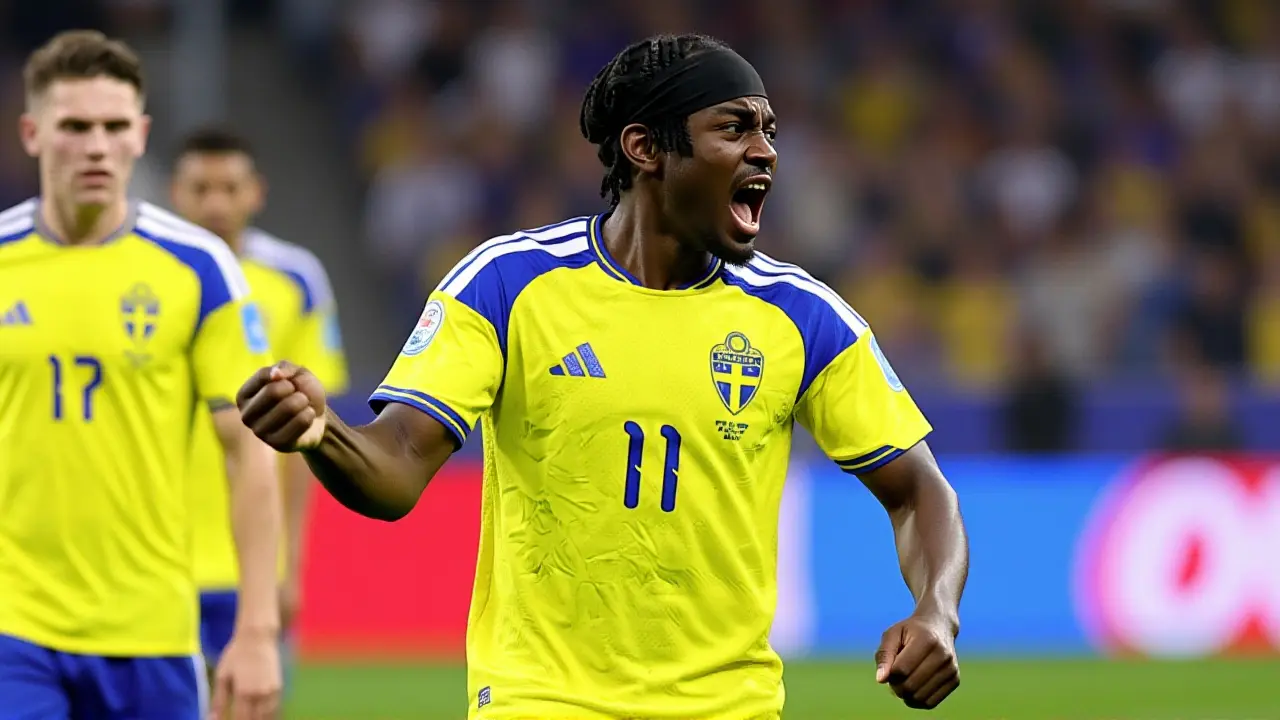
When Kylian Mbappé, forward for the France national football team stepped onto the pitch at MetLife Stadium in East Rutherford, New Jersey, on June 30, 2026, the atmosphere crackled with anticipation. The French side, heavy favorites after an undefeated group stage campaign, faced a resilient but injury-plagued Sweden national football team. Turns out, the odds were never really in doubt. France secured a decisive victory, advancing to the Round of 16 and leaving Sweden’s World Cup dreams in the dust.
The match, designated as Match 77 of the tournament, was less a contest and more a demonstration of tactical superiority. Here's the thing: while Sweden brought heart and grit, they lacked the firepower to counter France’s relentless attack. Opta’s supercomputer had predicted a 75.1% chance of a French win in regulation time, and the final whistle confirmed those numbers. For fans watching from across the globe, it was a reminder that in the modern World Cup, depth and individual brilliance often trump defensive organization.
Tactical Breakdown: A Mismatch in Midfield
Let’s look at how this unfolded. Didier Deschamps, manager of the France national football team, deployed a classic 4-2-3-1 formation. This setup allowed his midfield duo of Aurelien Tchouameni and Adrien Rabiot to control the tempo, suffocating Sweden’s attempts to build play from the back. On the wings, Ousmane Dembélé and Michael Olise caused constant chaos, stretching Sweden’s defense until it snapped.
But wait—Sweden wasn’t entirely passive. Head coach Graham Potter, head coach of the Sweden national football team, opted for a 3-4-3 system, hoping to overload the flanks with Anthony Elanga and Alexander Isak. The twist is that without key defender Isak Hien, who suffered a hamstring injury against Japan, Sweden’s back three looked exposed. Gustaf Lagerbielke, Victor Lindelöf, and Gabriel Gudmundsson worked tirelessly, but they couldn’t contain the sheer pace of Bradley Barcola and Mbappé.
Interestingly, the midfield battle was won early. Sweden’s quartet of Daniel Svensson, Lucas Bergvall, Yasin Ayari, and Elliot Stroud tried to press high, but France’s transition speed was too much. Every time Sweden lost possession, France was already moving forward. It’s like trying to catch a bullet with your bare hands.
Key Performances and Turning Points
Mbappé, already boasting four goals in the tournament, was instrumental. He didn’t just score; he dictated the game’s rhythm. His partnership with Dembélé—who added another hat-trick-worthy performance against Norway earlier in the week—was lethal. Meanwhile, William Saliba, returning from minor back pain, anchored the French defense with authority, marking Alexander Isak tightly.
On the Swedish side, Viktor Gyökeres showed flashes of brilliance, but he was often isolated. Without Isak Hien’s physical presence in central defense, Sweden struggled to clear dangerous balls into the box. One particular moment stands out: a swift counter-attack by France that ended with a clinical finish, highlighting the gap in quality between the two sides. As one analyst noted, "Sweden fought bravely, but you can’t outwork talent when it’s this good."
Betting Odds and Expert Predictions
Before kickoff, betting markets reflected the disparity. Covers’ Tom Oldfield, a veteran betting analyst, projected France’s attack to "completely outmatch Sweden." Indeed, the final result aligned with these expectations. Even The Athletic’s algorithm, "Algo," predicted a French victory, joining human experts Andy Jones and Elias Burke in favoring Les Bleus. Only Stanley the dog—a quirky subscriber prediction—backed Sweden, proving that sometimes, even pets know better than algorithms.
USA Today highlighted France’s dominance in Group I, where they scored ten goals against Senegal, Iraq, and Norway. This form carried over into the knockout stage. In contrast, Sweden’s path had been tougher, relying on narrow wins and defensive resilience. When push came to shove, France’s offensive firepower proved unstoppable.
What’s Next for Both Teams?
For France, the focus now shifts to the Round of 16. With Mbappé in sensational form and Dembélé firing on all cylinders, they’re genuine contenders for the title. Deschamps will likely rotate slightly to manage fatigue, but the core lineup remains intact. The question isn’t if they’ll advance, but how far they’ll go.
Sweden, meanwhile, faces a painful exit. Potter will need to assess why his attacking philosophy didn’t translate into results against top-tier opposition. The absence of Isak Hien was significant, but deeper structural issues may have contributed. Still, young talents like Bergvall and Stroud showed promise, suggesting a bright future despite this setback.
Historical Context and Legacy
This match echoes previous World Cup encounters where technical superiority overwhelmed tactical discipline. Remember Paraguay’s upset? Or Brazil’s struggles against Germany in 2014? While Sweden didn’t cause an upset, their effort was commendable. However, in a tournament featuring 48 teams, consistency is key. France has shown they possess both.
Looking back, this fixture serves as a case study in modern football. Speed, precision, and depth matter more than ever. Sweden’s brave display won’t be forgotten, but France’s march toward glory continues. As Darren Fletcher and Owen Hargreaves noted during Fox Sports’ highlights, "This is what winning looks like."
Frequently Asked Questions
Who managed the France team in this match?
Didier Deschamps managed the France national football team. He implemented a 4-2-3-1 formation that effectively neutralized Sweden’s attack and maximized the strengths of players like Kylian Mbappé and Ousmane Dembélé.
Why was Isak Hien absent for Sweden?
Isak Hien suffered a hamstring injury during Sweden’s previous match against Japan. This ruled him out for the remainder of the tournament, significantly weakening Sweden’s defensive options against France’s potent attack.
What was the final outcome of the match?
France defeated Sweden to advance to the Round of 16 of the 2026 FIFA World Cup. The victory was consistent with pre-match predictions, including those from Opta’s supercomputer which gave France a 75.1% win probability.
Which stadium hosted this Round of 32 match?
The match took place at MetLife Stadium (also known as New York New Jersey Stadium) in East Rutherford, New Jersey, United States. It was the 77th match of the tournament.
How did Sweden’s coach Graham Potter set up his team?
Graham Potter utilized a 3-4-3 formation, aiming to exploit wide areas with Anthony Elanga and Alexander Isak. However, the lack of defensive solidity due to injuries limited their effectiveness against France’s fast transitions.
17 Comments
Navya Anish July 2 2026
Oh please, spare me the breathless worship of Mbappé. 🙄 It’s not a 'crushing' victory, it’s just France playing against a team missing their best defender. If Hien was there, we’d be having a very different conversation about tactical nuance and defensive resilience. But no, let’s just praise the obvious because it’s easier than analyzing why Sweden’s midfield got overrun by pace rather than skill. Typical media narrative.
Subramanian Raman July 3 2026
One must consider the philosophical implications of talent versus structure. : ) While France displays raw power, Sweden’s attempt to impose order through a 3-4-3 without key personnel is a tragic study in futility. The universe favors the prepared mind, or perhaps, the prepared squad depth. It is a sad day for those who believe grit alone can stop a bullet train. 😔
Shreyanshu Singh July 3 2026
deschamps is basically cheating with that formation lol. Tchouameni and Rabiot controlling the tempo? yeah right they just parked the bus and countered. sweden tried to play football and got punished for it. typical boring france win where they rely on individual brilliance instead of actual team cohesion. yawn.
Sohni Bhatt July 5 2026
I find it utterly exhausting how everyone ignores the sheer intellectual superiority of Didier Deschamps’ setup compared to Graham Potter’s chaotic 3-4-3 experiment. To think that anyone could argue this was a contest is laughable; it was a masterclass in spatial domination and transitional efficiency, showcasing exactly why European football remains leagues ahead of any other stylistic approach. The absence of Isak Hien merely highlighted the structural fragility of the Swedish backline, which was already compromised by a lack of cohesive understanding, proving that tactical discipline cannot be replaced by mere enthusiasm or youthful energy. One must appreciate the elegance of the 4-2-3-1 when executed with such precision, as it suffocates the opponent’s ability to breathe, let alone attack, thereby rendering any counter-arguments regarding 'heart' or 'grit' completely irrelevant in the face of cold, hard statistical dominance.
Prashant Sharma July 6 2026
The notion that this match was anything other than a foregone conclusion is intellectually dishonest. Opta’s supercomputer predicted a 75.1% chance, yet here we are acting surprised. It is amusing how people cling to the idea of an upset when the data has spoken clearly for weeks. France did not just win; they validated the algorithmic certainty of modern sports analytics. To suggest otherwise is to ignore reality.
Mike Gill July 8 2026
hey guys dont be so harsh on sweden man. they played with heart even without hien. mike gill thinks its important to support underdogs too. keep fighting sweden u got this next time 💪
Suresh Kumar July 9 2026
Silence speaks louder than words. The void left by Hien is palpable. France filled it with noise and goals. We observe. We do not judge. The ball rolls forward regardless of our opinions.
Jay Patel July 9 2026
Let’s be real, folks. 🧐 This wasn’t just a win; it was a statement. Mbappé isn’t just playing football; he’s rewriting the laws of physics on that pitch. 🚀 The way he dictated the rhythm while Dembélé caused chaos on the wings? Chef’s kiss! 👨🍳 Sweden tried to press, but you can’t catch lightning in a bottle, especially when the bottle is made of glass and France is holding a hammer. 🔨 Respect to Potter for trying, but some gaps are just too wide to bridge with passion alone. France is built different. 🇫🇷✨
Pranav Gopal July 11 2026
It is interesting to see how different formations interact under pressure. While France dominated, it is worth noting that Sweden's young talents like Bergvall showed promise. We should encourage development over immediate results. Football is a long game.
कमल कमल July 11 2026
Why does everyone praise French football so much? It is all flash and no substance compared to the disciplined systems we see elsewhere. The fact that they needed to crush a weakened Sweden to prove their worth says everything about their reliance on individual stars rather than collective harmony. I have always believed that true footballing excellence comes from rigorous training and unity, not just relying on one or two superstars to carry the team. This match was a clear example of how superficial success can mask deeper issues in tactical coherence, and I find it disturbing that the media celebrates such imbalance. We need to question these narratives and look deeper into what constitutes real sporting integrity.
harsh gupta July 13 2026
Stanley the dog backed Sweden. Maybe the dog knows something the algorithms don't. Or maybe the whole thing is rigged to make France look good for sponsors. Who really benefits from this narrative? Follow the money. The 'tactical superiority' is just marketing fluff.
Mukesh Katira July 13 2026
It is morally incumbent upon us to recognize the disparity in resources between nations. France’s victory is a testament to their infrastructure, but it also highlights the inequities in global football. We must reflect on whether such dominance stifles competition and excitement. A balanced tournament requires more than just the strongest teams prevailing; it requires fairness and opportunity for all.
Roop Kaur July 14 2026
So the paradigm shift in xG metrics indicates a systemic failure in Sweden’s defensive block. Simple terms: they got owned. The jargon-heavy analysis suggests a conspiracy of silence around Deschamps’ tactics. Everyone sees it but no one talks about it. Extroverted observation confirms the bias.
Ankita Bajaj July 15 2026
Hey everyone! Let’s give it up for both teams! France played great, but Sweden fought hard too. Go Sweden! You’ll bounce back stronger! 🌟 Keep believing in your dreams!
Manish gupta July 15 2026
Oh wow, another boring France win. How original. I guess we’re supposed to be impressed that they scored against a team missing half its defense. Real thrill there. Not. The drama king in me wants to scream at the TV, but honestly, it’s just sad. Where’s the challenge? Where’s the upset? Nowhere. Just more of the same old stuff. Yawn.
Sanjay Kumar July 16 2026
Think about the bigger picture. Football is life. France showed strength, Sweden showed character. Both are valuable lessons. Support your team, learn from losses, and keep moving forward. That’s the spirit.
Gaurav Jangid July 17 2026
Ugh!!! Why do I even bother watching?! 😭😭😭 The pain!!! The agony!!! Sweden tried so hard!!! And France just... destroyed them!!! It hurts my soul!!! 💔💔💔 I’m drained!!! Emotionally bankrupt!!! Can someone please refill my emotional cup?! ☕️☕️☕️ This is too much!!! Too intense!!! I need a break!!! 😫😫😫