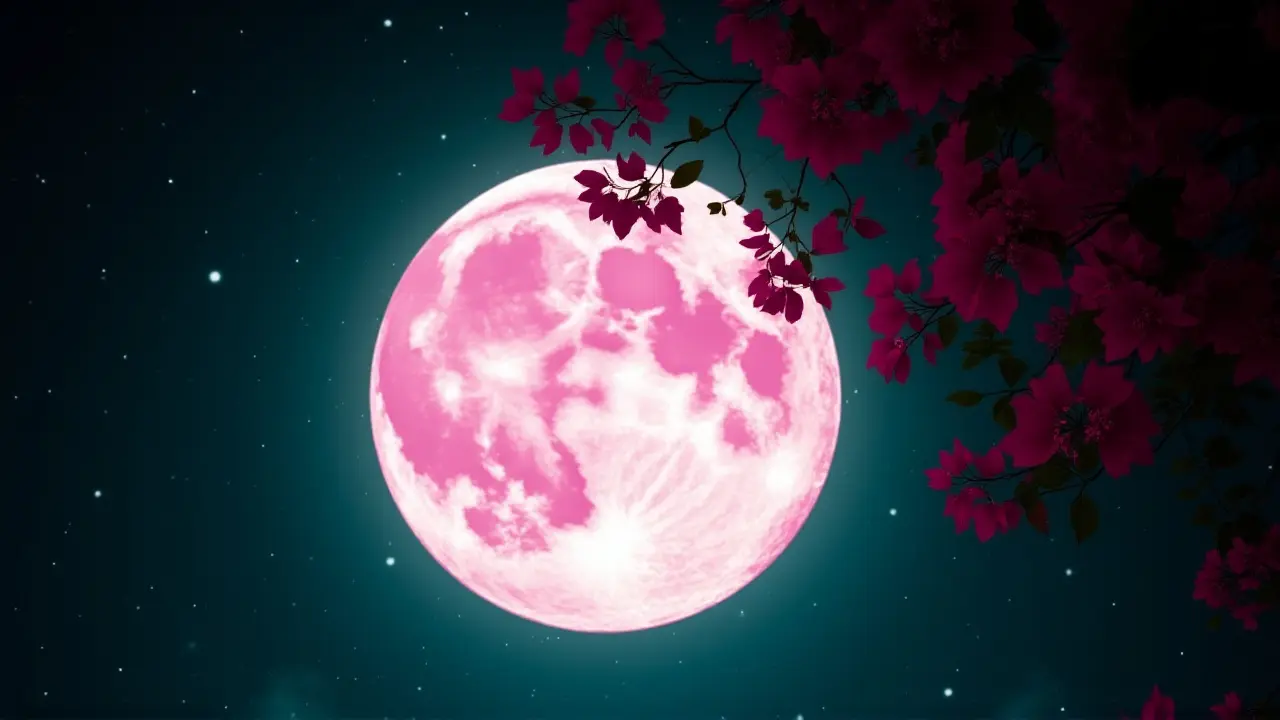
Get ready to look up on the April 2026 Full Moon , widely recognized as the Pink Moon. While the name suggests a pastel hue, the moon won't actually blush—it stays its usual silvery white. Instead, the nickname pays homage to the wild ground phlox flowers blooming across North America. The peak illumination hits exactly at 02:11 UTC on April 2, 2026, but depending on where you stand on the globe, you might see it peak late evening on April 1 instead.
This celestial alignment isn't just pretty window dressing. It carries weight in our calendars. The timing of this specific lunar cycle locks in the date for Easter Sunday 2026 . That means churches worldwide are scheduling their Holy Days based on this exact orbit. Plus, for Jewish communities, this moon marks the start of Passover. You can tell the universe runs on tight schedules when the moon dictates your holidays.
The Real Story Behind the Pink Moon
Here's the twist: the "pink" comes from the earth, not the sky. In early spring, the purple-pink blossoms of the Phlox subulata carpet the ground. Native Americans, specifically the Algonquian tribes, named this month after these resilient blooms. It signals renewal. So, when astronomers say "Pink Moon," think spring cleaning for nature, not a color shift for the orb.
If you're hoping for a literal pink glow, you've got to catch the moonrise right. As the disk climbs just above the eastern horizon, it often picks up a yellow-orange tint. This happens because the light travels through more atmosphere, scattering the blue waves and leaving the warm colors. By the time it reaches zenith overhead, it shifts back to pure white or blue-gray. Timing is everything here.
Global Viewing Times and Zones
Your phone clock is the enemy of good astronomy. Because the moon moves in Universal Coordinated Time, local peaks get scattered. If you are in New York, the show peaks at 10:11 PM EDT on April 1. But folks in London will wait until 3:11 AM BST on April 2. Over in Sydney, the peak is at 1:12 PM AEDT on April 2—meaning the full moon arrives in daylight there, though the disk looks full the night before.
Even within a country, things vary. New York sees moonrise at 7:14 PM, while Chicago sees it slightly earlier at 7:12 PM CDT. Denver follows at 7:22 PM MDT. These differences matter if you want to photograph the moon rising over a skyline. You need that specific window of overlap between twilight and elevation.
Astronomy Buffs: Watch for Spica
The real treat for serious observers is the company the moon keeps. This April, the moon passes directly through the constellation Virgo. Specifically, keep an eye out for Spica, that bright blue-white star sitting in the constellation's lower left. On the night of April 1, the moon sits roughly 10 degrees away—about the width of your clenched fist held at arm's length. On April 2, they get closer, separated by just 1.8 degrees. It's a subtle pairing, but spotting them together confirms you know your sky.
To help plan this, many people rely on tools like Stellarium or SkySafari. These apps calculate exact rise and set times based on your GPS coordinates. Without them, you're just guessing when the clouds might roll in.
Religious Timelines and Lunar Calendars
Beyond the backyard telescope, this moon drives major religious dates. The Gregorian calendar ties Western Easter to the first Sunday after the first ecclesiastical full moon following the vernal equinox. Since this full moon lands on April 2, Easter gets pushed to April 5. That affects everything from school schedules to travel bookings in Rome and Canterbury.
Simultaneously, the Hebrew calendar, which tracks months by the sun and stars, aligns Passover with this cycle. The festival begins at sunset on April 1, 2026, marking the 15th day of Nisan. It's fascinating how one lunar event anchors faiths across continents. The lunisolar rhythm remains constant, even as our digital calendars update.
What’s Ahead for the Rest of 2026
Don't pack away the binoculars yet. This pink spectacle kicks off a busy lunar year. In May, we get the Flower Moon on May 31. Then, shortly after, the heavens deliver a rare anomaly: a Blue Moon. This occurs when two full moons fall in one calendar month, meaning the second one gets the honorary title. Keep your eyes peeled for that double-header later in spring.
For now, find a spot away from city lights. The glare from streetlamps washes out the surface detail of the cratered landscape. Drive out to a darker patch of sky, wait for the horizon to clear, and watch the old satellite rise. Whether you call it the Pink Moon or just another phase, there's something grounding about knowing exactly where we sit in the cosmos.
Frequently Asked Questions
Will the Pink Moon actually appear pink in the sky?
No, the moon will not change color to pink. The name references the blooming phlox flowers on Earth. However, the moon may appear yellow-orange during moonrise due to atmospheric scattering before turning white overhead.
How does the Pink Moon affect the Easter holiday date?
Western Easter is set by the first Sunday after the first full moon following the spring equinox. Because the April 2026 full moon occurs on April 2, Easter is scheduled for Sunday, April 5, 2026.
What special stars will be visible near the April 2026 full moon?
The moon will pass near Spica, a bright blue-white star in the Virgo constellation. They will be visible close together on April 1 and even closer on April 2, offering a notable sight for stargazers with dark skies.
When does the Jewish festival of Passover begin in 2026?
Passover, or Pesach, begins at sunset on April 1, 2026. This timing aligns with the full moon of the Hebrew month of Nisan, linking the holiday to the same lunar cycle seen globally as the Pink Moon.
Is there another special full moon coming later in 2026?
Yes, a Blue Moon will occur in May 2026 at 4:45 AM EDT. This happens when two full moons fall in a single calendar month, making it a rarer occurrence compared to the monthly Pink Moon.
16 Comments
Paul Smith April 2 2026
So many people get so confused about this name thing. It is not actually pink in color obviously. I mean think about the flowers down on the ground. They pop up everywhere in the springtime season here. My grandma used to tell me stories about phlox bushes. She said they were magical to the old native tribes. It makes sense why they named the whole month after it. You know how nature works with these cycles of blooming. We just stop noticing those small signs around us anymore. Modern life makes us ignore the seasons changing slowly. But the moon doesn't care about our busy schedules. It follows its own path without any hesitation whatsoever. Watching it rise reminds you of something bigger than yourself. That is why we should go outside more often in the dark. It brings peace to the mind and soul deeply. Plus the flowers smell wonderful when you walk near them.
jagrut jain April 3 2026
I suppose hoping for magic is more fun than reality most times.
Ashish Gupta April 4 2026
Spica is so cool! 🌟 Moon looks amazing 🌙 Can't wait to snap pics with my camera 📸 The sky is gonna look awesome tomorrow night!! 🤩
Pranav nair April 5 2026
Yeah I think its pretty neat : ) Not much else to add really ; ) Hope you get good shots though
Santosh Sharma April 6 2026
people always forget how easter ties into the moon cycle i think this is super important for history buffs especially in india where we also track lunar calendars it helps to know the roots of our holidays and traditions
Pankaj Verma April 8 2026
While that is true the ecclesiastical calculation is different from the astronomical observation so you cant simply equate the two systems directly without understanding the drift
priyanka rajapurkar April 9 2026
oh yeah because the sky turns into a cotton candy shop every april who knew nature was that sweet lol seriously though nobody expects the magenta orb
Rashi Jain April 10 2026
The physics behind the colors is quite interesting to note. Atmosphere scatters light waves depending on particle density. Blue light gets scattered away much faster than red ones. This creates the warmer hues we see during moonrise moments. By the time it reaches zenith there is less atmosphere. So it returns to white or slightly blue-grey shade naturally. Humidity plays a massive role in how bright it appears. Dust in the air also blocks certain wavelengths significantly. Pollution can change the hue to brownish yellow tones sometimes. Clean skies offer the best view for photography purposes mainly. You need a dark location away from city lights glare. Street lamps ruin the exposure settings on digital cameras easily. Tripods help a lot with keeping the image steady overall. Patience is key when waiting for the perfect horizon line. Clouds rolling in can end your session instantly unfortunately.
Sathyavathi S April 10 2026
Oh honey you forgot to mention the refraction index changes with temperature inversions which is why sometimes it looks greenish during solar eclipses although that is different entirely
Arumugam kumarasamy April 11 2026
Amateurism plagues this community when discussing celestial mechanics. Precision is paramount. One must study the orbital dynamics before posting such simplistic theories.
Robin Godden April 12 2026
We should all strive to understand the stars together regardless of our skill level today.
Suman Rida April 14 2026
It is quiet nice to read about the details of the lunar cycle.
Suraj Narayan April 15 2026
Stop hiding indoors and go watch the moon!
Dr. Sanjay Kumar April 16 2026
The sheer magnitude of the darkness surrounding us is humbling beyond measure and truly awe inspiring to behold.
Raman Deep April 18 2026
u r right lets go see it! 🌕🔭 gona take my binoculers tonight for sure !! 📷😎
Ashish Gupta April 18 2026
I will definitely bring my camera 📷 next time! Thanks for sharing 😊✨